

![50ml Mogake ”藻掛“ Shudei Shiboridashi [Hakusan Kiln]](http://cominstea.com/cdn/shop/files/46C7DFD3-2F17-44BC-84A1-A708990B98E3_1024x1024.jpg?v=1783586825)
![50ml Mogake ”藻掛“ Shudei Shiboridashi [Hakusan Kiln]](http://cominstea.com/cdn/shop/files/7260F00F-20C0-4C7C-99B2-D37C17A8A57A_1024x1024.jpg?v=1783586825)
![50ml Mogake ”藻掛“ Shudei Shiboridashi [Hakusan Kiln]](http://cominstea.com/cdn/shop/files/8B2C69BB-1F91-4743-AD1A-6D9B56D3F69A_1024x1024.jpg?v=1783586825)
![50ml Mogake ”藻掛“ Shudei Shiboridashi [Hakusan Kiln]](http://cominstea.com/cdn/shop/files/25C5BA81-A35F-446E-ACB3-6082F5AAB297_1024x1024.jpg?v=1783586824)
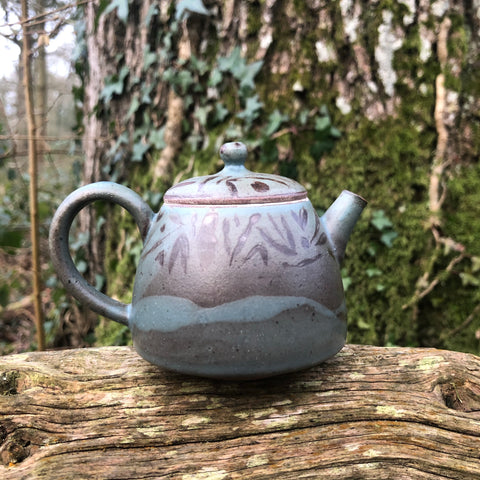
50ml Mogake ”藻掛“ Shudei Shiboridashi [Hakusan Kiln]
DESCRIPTION
This beautiful hand crafted Mogake ”藻掛“ Shudei Tokoname-yaki shiboridashi is from the highly respected Hakusan kiln
SPECIFICATION
Capacity : 50ml
About the Hakusan Kiln
Kiln: HAKUSAN Kiln
Name of Master: Katayama Hakusan (白山),
Born : Born in 1949
Education : His grandfather established the pottery in 1935 and after graduating from the Tokoname High School ceramic course he studied with his father [Tadayoshi KATAYAMA] from 1968.
Signature style of tea pots : Third generation master ceramicist most famous for his signature mogake (seaweed) technique.
Notable Awards
* Choza Award Ceramic Craft Exhibition Encouraging Prize 2 times, win 3 times
* Japan Sencha Crafts Exhibition, Encouraging Prize 5 times, win more than 21 times
* Tokai Traditional Crafts Exhibition win 2 times
* Tokoname Cultural Festival Exhibition Jozan Prize
* Hand-made Teapot Exhibition Chair Prize 3 times, School Board Chairman Prize
* Tokoname City Art Exhibition, Encouraging Prize 2 times
All about Tokoname
A short history : The Tokoname region is considered the teaware capital of Japan. This area’s link with pottery dates back to 1100 and is believed to be the oldest in Japan. However, it wasn’t until the start of the Edo period (1603–1868) that this area became important. In early times it focused mostly on vases and jars, but this period also produced the early matcha bowls in the form of yama-chawans (mountain tea bowls). These were coarsely finished bowls with little refinement, but beautiful in their simplicity.
The events that shaped Tokoname teaware :Today Tokoname is famous for its redware teapots (kyusu), introduced in the early 1860s. Other teapots for green tea had been produced from early in the nineteenth century in Tokoname, but this new style became very popular. Again it was influenced by China, whose own redware teapots were the typical teaware used at this time. The name comes from the deep red, iron-rich clay from which it is made. Its use in Japan had a big effect on Tokoname’s ceramic industry, with an influx of new potters who specialized in making redware teapots. This was helped by the visit of a Chinese potter called Jin Shi Heng who, in 1878, was invited to teach Chinese techniques for making teapots, greatly accelerating development and increasing quality. This, combined with a period of rapid industrialization, eventually meant mass-production hit Tokoname towards the end of the nineteenth century, with much small-scale domestic production replaced with industrial-scale manufacturing.
Tokoname Today : Today Tokoname is a place of great diversity, incorporating both small and large-scale manufacture - something reflected in our selection of pieces. It is still best known for its iconic brick-red clay called shudei [朱泥 - vermilion clay]. It should be noted that honshudei (本朱泥 - real/true shudei) the original clay - is now rare [as we have seen on our trips] - many potters use modern formulations that approximate its colour and effect on tea profile. As well as shudei there are many other types of clay in use in modern day Tokoname including Koudei [yellow], Ryokudei [green] and Kokudei [black]
Why use a Tokoname Teapot? The vibrant colour of shudei comes from its rich iron content which is said to react chemically with the tannins in green tea resulting in a mellow cup. Tokoname ware is also unglazed & naturally porous - a characteristic which is said to enable absorption of impurities from water - making for a smoother cup.
Styles of Tokoname Teapot There are three possible forms of Tokoname teapots, categorized according to where the handle is sited. A yokode kyusu has it on the side, an ushirode kyusu has it at the back and an uwade kyusu has a handle on the top. The most typical modern type is the yokode kyusu, which is the one we use at Comins. This style can be traced back to the end of the Song dynasty (960–1279) in China for the preparation of powdered tea. It has been adapted perfectly over time to meet Japanese needs, incorporating a fine mesh to prevent the fine particles of tea from coming out. Each one is balanced according to the potter’s preferences. Customers often comment how simple yet effective their design is, not knowing that the concept has not really changed in 900 years!
![230ml Maru-gata (丸形) gold flower Ikomi Kokudei kyusu with sesame strainer [Shōhō Kiln]](http://cominstea.com/cdn/shop/files/A09CF4B3-4082-40E2-992A-54D74926C749_large.jpg?v=1780838744)
![‘Xing Xiang Clay Pot' : Xing Xiang [Yu Xinrong] Jingdezhen](http://cominstea.com/cdn/shop/products/image_a3475563-2ec6-4c5a-950e-72eca9a93f85_large.jpg?v=1613410372)
![200ml Yellow Black Yōhen Kyusu with sesame filter [Hakusan Kiln]](http://cominstea.com/cdn/shop/files/F972971E-021F-4573-A84E-3F51816AA02D_large.jpg?v=1783585507)